
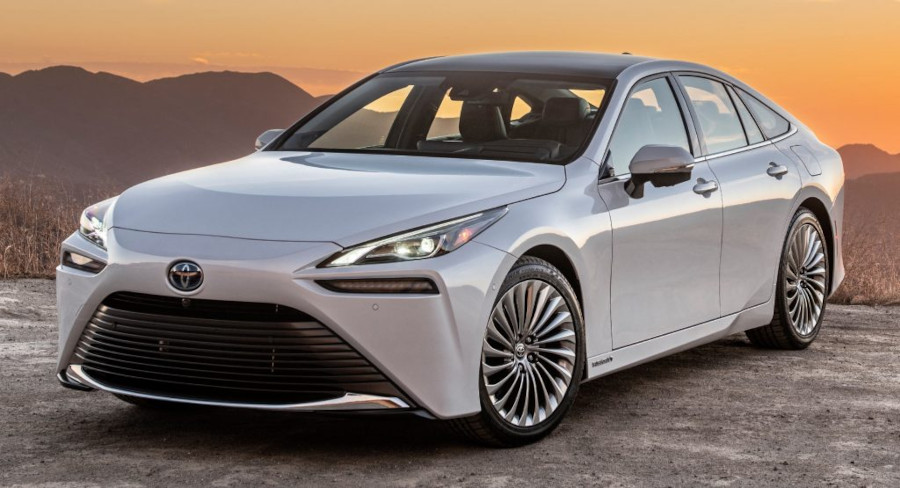

India has begun real-world testing of the Toyota Mirai, a hydrogen fuel-cell electric vehicle (FCEV), marking a major step toward evaluating whether hydrogen can become a practical clean-mobility solution for the country. The pilot, launched in December 2025, places the Mirai at the centre of India’s hydrogen transportation push, with performance trials designed to measure how the technology holds up across Indian roads, weather, traffic, and operating conditions.
The programme was launched under the Ministry of New & Renewable Energy (MNRE) as part of the broader direction set by the National Green Hydrogen Mission. As part of the initiative, Toyota Kirloskar Motor (TKM) handed over a second-generation Toyota Mirai to the National Institute of Solar Energy (NISE) for structured field evaluation. The project was flagged off in New Delhi, with Union Minister Pralhad Joshi also driving the vehicle during the launch, signalling official intent to move from policy discussion to on-ground trials.
At the core of the testing is a simple question: Can hydrogen fuel-cell vehicles work reliably and efficiently in India? Over the next two years, NISE will assess the Mirai’s day-to-day performance in conditions that are far more demanding than controlled test environments. The evaluation will include factors such as driving range, fuel efficiency, drivability, refueling behavior, and durability under India’s diverse operational realities.
The Toyota Mirai represents a different approach to zero-emission driving than battery electric vehicles. Instead of storing electricity in a large battery, it produces electricity onboard through a chemical reaction between hydrogen and oxygen inside a fuel cell. The result is smooth electric propulsion with a tailpipe emission that is only water vapour.
Globally, the Mirai is known for offering long driving range and fast refueling, and reports around the India pilot highlight that the vehicle can deliver around 650 km range with a refuel time of under five minutes, a key advantage in conversations about convenience and long-distance mobility.
India’s test program is structured to generate evidence-based answers, not assumptions. During the trial period, the Mirai will be evaluated across varying road and climate conditions, including high temperatures, dust-heavy environments, humidity, congestion, and mixed road quality. These are crucial parameters for India, where vehicles often face intense heat, irregular traffic flow, and high usage patterns. The trial is expected to help determine how hydrogen systems perform when exposed to everyday realities rather than ideal conditions.
Beyond the vehicle itself, the pilot also highlights the importance of ecosystem readiness. Hydrogen mobility depends not only on vehicle technology, but also on safe hydrogen production, storage, transport, and refueling infrastructure. For hydrogen vehicles to scale, India will need reliable fuel supply chains and refueling networks—areas still in early stages compared to petrol pumps or EV charging stations. This is why the Mirai trial is being seen as a foundational learning exercise: it helps stakeholders understand what will be required to move from demonstration to adoption.
For Toyota, the India testing initiative places the Mirai in a new and strategically important market. While fuel-cell vehicles have been showcased in select global regions, India’s entry into formal testing signals growing interest in hydrogen as a complementary pathway to electrification. For policy planners and researchers, the project also strengthens the model of collaboration between government, industry, and technical institutions, which is essential for emerging clean technologies.
In the larger picture, the Toyota Mirai’s late-2025 trials represent more than a symbolic launch. They are a practical attempt to study whether hydrogen fuel-cell mobility can support India’s clean transport goals alongside battery EVs and hybrids. If the results are positive, the program could become a blueprint for future pilots, infrastructure planning, and eventual commercial rollout. If challenges emerge, the trial will still deliver valuable insights—helping India refine its hydrogen roadmap with real data rather than speculation