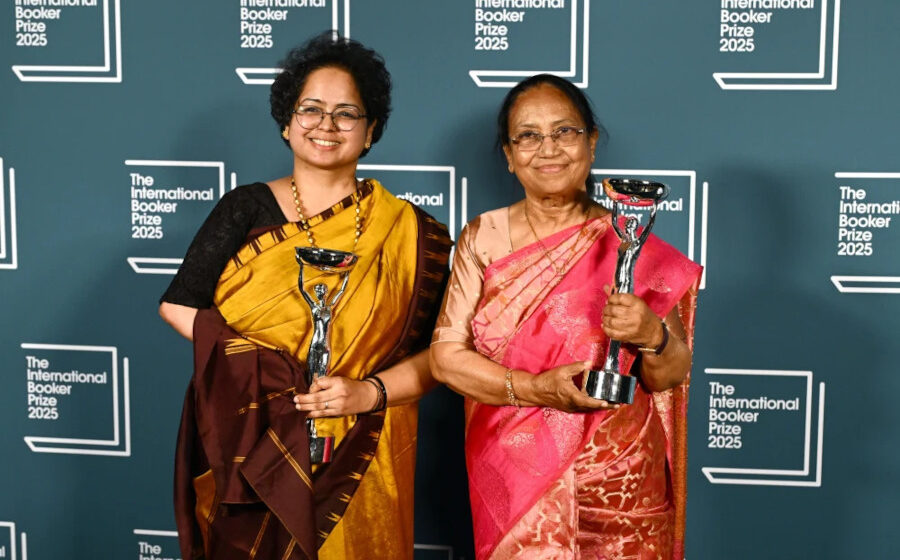

Banu Mushtaq, the Indian writer, activist and lawyer, has won the 2025 International Booker Prize for her short story collection Heart Lamp: Selected Stories, marking a major milestone for Indian literature in translation.
The award, announced at a ceremony at Tate Modern in London on 20 May 2025, recognizes Heart Lamp as the year’s most outstanding work of translated fiction. The £50,000 prize is shared equally between Mushtaq and her translator Deepa Bhasthi, shining a spotlight not only on the author’s storytelling but also on the crucial role of translation in taking regional voices to the world stage.
Heart Lamp has created history as the first Kannada-language work to win the International Booker Prize and the first short story collection ever to receive the honour. The book brings together 12 stories written across decades, offering vivid portrayals of women navigating patriarchy, inequality, and social constraints in southern India. With emotional precision and sharp realism, the collection captures both hardship and resilience, blending everyday detail with deeper social critique.
Mushtaq’s win has been widely celebrated as a breakthrough moment for Kannada literature and regional Indian storytelling. It has also triggered a renewed national conversation on how powerful narratives from non-metropolitan, non-English literary traditions can resonate globally when translated with care and authenticity.
A Lifetime of Resistance and Storytelling
Born in Karnataka, Mushtaq has long been associated with progressive and protest literary circles. Over the years, she has published multiple short story collections, a novel, essays and poetry in Kannada, often focusing on themes of gender, justice, and the lived realities of marginalized communities. Her work has consistently challenged social norms, bringing uncomfortable truths into the open with a writer’s sharp eye and a reformer’s urgency.
Translator Deepa Bhasthi curated the stories for Heart Lamp from a much larger body of Mushtaq’s work, selecting pieces that reflect the breadth of her themes and the evolution of her voice. The translation has been praised for retaining cultural texture while remaining accessible to international readers—an achievement that helped the book stand out on a highly competitive global shortlist.
Life After the Booker Win
In the weeks following the award, Mushtaq has spoken about the recognition as more than a personal achievement, framing it as a victory for the voices she has always written about. In interviews, she reaffirmed her commitment to fearless writing and social questioning, describing rebellion and truth-telling as central to her identity as an author.
At the same time, her growing global visibility has also brought scrutiny and criticism from conservative sections, reflecting the tensions her writing often confronts head-on.
What This Win Means
Banu Mushtaq’s International Booker Prize win is not just a literary triumph—it is a cultural moment. It signals a widening global appetite for stories rooted in local realities and told in languages often underrepresented in international publishing. With Heart Lamp, Mushtaq has shown that the most powerful literature does not need to be loud to be revolutionary—it only needs to be honest.